

What Is eNPS? The Employee Net Promoter Score, Explained
 ··5 min read
Ask a room of HR leaders how their people feel about working there and you'll get a dozen answers, most of them anecdotes. The employee Net Promoter Score (eNPS for short) replaces the anecdotes with one number you can track over time. The whole thing is a single question and a little arithmetic.
What is eNPS?
eNPS is a measure of employee loyalty, adapted from the customer-facing Net Promoter Score that companies have used for two decades. Where NPS asks customers how likely they are to recommend a product, eNPS asks employees one thing:
On a scale of 0 to 10, how likely are you to recommend this company as a place to work?
That's the whole instrument. Everyone answers the same question on the same 0–10 scale, and the answers roll up into a single score between −100 and +100. Because the question and the maths never change, you can track the result over time and compare it between teams, even roughly against other companies. Few employee-experience metrics can say that.
How to calculate eNPS
Every response lands in one of three groups based on the 0–10 rating:
- Promoters (9–10): genuinely enthusiastic. They'd recommend you unprompted.
- Passives (7–8): satisfied but unattached. They won't badmouth you, and they won't screen a recruiter's call either.
- Detractors (0–6): disengaged, and quietly updating their CVs.
Then the formula:
eNPS = % Promoters − % Detractors
Passives count toward the total number of responses but drop out of the subtraction. Worked example: in a team of 50, if 25 people score 9–10 (50% promoters), 15 score 7–8 (passives), and 10 score 0–6 (20% detractors), your eNPS is 50 − 20 = +30.
Notice what's missing: there's no averaging. The result is a whole number from −100 (everyone's a detractor) to +100 (everyone's a promoter), and a score of 30 doesn't mean "people rated us 3 out of 10". It means promoters outnumber detractors by 30 percentage points.
What's a good score?
There's no universal pass mark, but the usual rules of thumb look like this:
- Above 0: more promoters than detractors. The floor for "healthy".
- 10 to 30: solid for most organizations.
- 30 to 50: strong. Your people are actively engaged.
- 50+: excellent, and rare.
- Below 0: your detractors outnumber your enthusiasts. Treat it as a fire alarm.
Benchmarks vary by industry, company size and region, so treat any single "good score" figure with suspicion. What matters far more is movement. A +20 that was +45 two quarters ago is a very different company from a +20 that was +5. Watch the line, not the number.
Why the scoring feels harsh
The first time you see the buckets, they look unfair. A 7 or an 8 sounds like a decent answer, yet it counts for nothing. A 6 sounds only slightly worse, yet it counts against you.
That harshness is deliberate. People are polite. Asked to rate almost anything, most of us hand out 7s the way we say "fine, thanks", because it's the answer that ends the conversation. eNPS strips that politeness out of the signal: only genuine enthusiasm counts in your favour, and everything lukewarm counts as a warning, because lukewarm employees are the ones with one foot out the door.
So a score of zero doesn't mean "average". It means your enthusiasts and your flight risks are exactly balanced. Healthy teams land well above it.
eNPS vs NPS
Same maths, same 0–10 scale, different audience. NPS asks customers how likely they are to recommend your product, so it measures customer loyalty. eNPS asks employees how likely they are to recommend your company as a place to work, so it measures employee loyalty and engagement. The shared method is a feature: if your leadership already tracks customer NPS, eNPS drops into the same mental model with no new vocabulary to learn.
How to run it so the answers are honest
The question is free. All the value is in how you run it, and this is where most eNPS programs quietly fail.
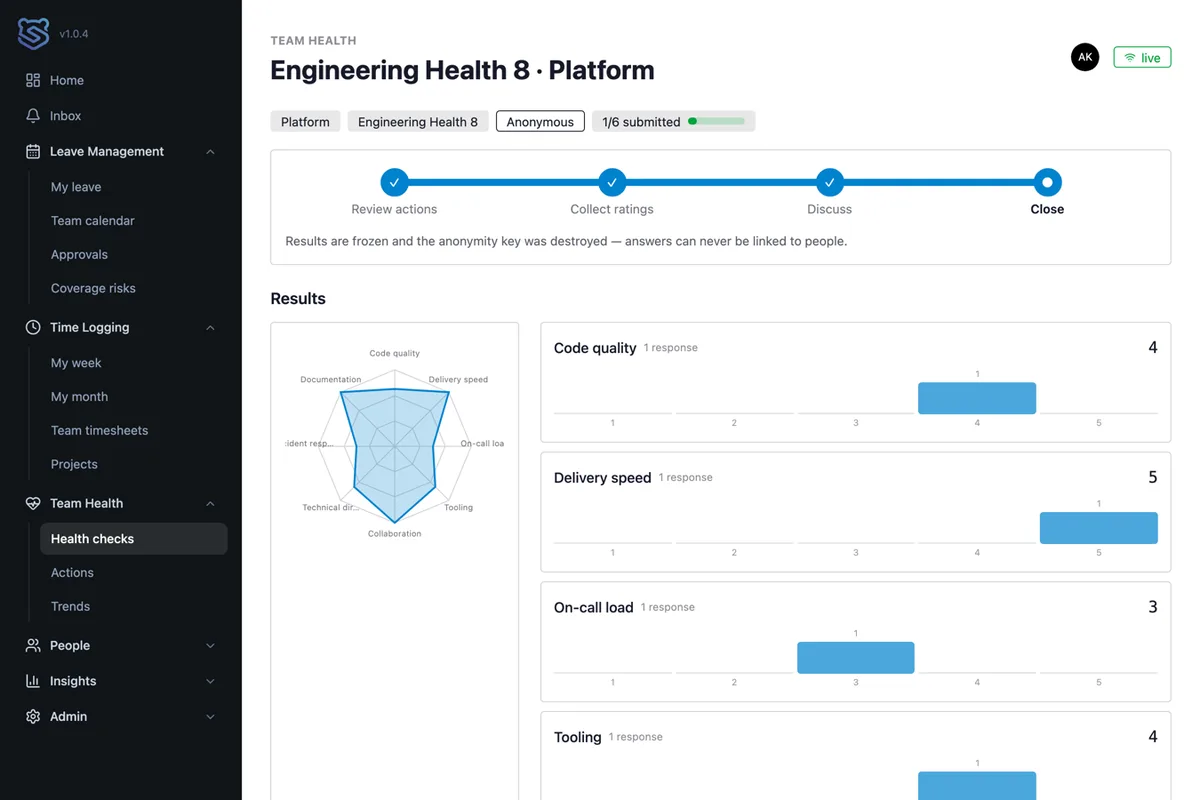
Make the anonymity believable. An eNPS is only as honest as people believe it is anonymous. If scores can be traced back later, whether by an admin with database access or by process of elimination on a small team, people learn to answer 8 and move on, and your score becomes decorative. SquadBear handles this structurally: the score is computed from the distribution of ratings a run collected, and that distribution is frozen the moment the run closes. In alias or anonymous mode, closing also permanently burns the link between people and their answers. There's no per-response data left to export or leak afterward, only the aggregate.
Track the trend, not the trophy. One reading tells you little. In SquadBear, every eNPS run lands on its team's Trends timeline, plotted as the −100 to +100 score and never as the raw 0–10 average (those are different units, and averaging would hide exactly the lukewarm middle the method is built to expose). The score becomes a line you can watch instead of a number you announce once a year. Two practical notes: there's no minimum group size, so a small team's score is visible from the first response, and there's no built-in recurring schedule. A quarterly cadence is a habit your workspace keeps, not a setting you flip.
Accept what one number can't do. eNPS tells you where you stand, never why. A company-wide +25 can hide a team in real trouble, and a bare score with no context is a thermometer without a diagnosis. When a low read needs an answer to "which part of work is the problem", run a multi-dimension health check instead. SquadBear ships Pulse 5 and Team Health 11 for exactly this: the same idea split across several named dimensions instead of one.
Close the loop. The failure mode of every engagement metric is the ritual: measure, present, file away, repeat. People notice when nothing changes, and the next score comes back a little lower and a little less honest. So treat a dip as a trigger. Whatever you decide to fix should have an owner and a date, visible to the team, before you ask again.
Measure your team's eNPS in SquadBear
eNPS is a built-in dimension of SquadBear's team health checks. The question ships fixed (you can't reword it, which is what keeps the score comparable), the scoring is the standard split above, and every run is anchored to a team whose Trends page carries the line. If you work through the AI assistant, running one takes a sentence:
Start an anonymous eNPS check for the engineering team, open it now, and tell me the score once everyone's answered.
Show me the engineering team's eNPS trend.
Try it against the demo, or start free and send your first check this week.
Earlier in this series: burnout tracking without the Big Brother, on reading team health without surveilling the people in it.